Starboard’s latest in-depth CFD (Computational Fluid Dynamics) analysis uncovers clear distinctions between two of the brand’s best-selling paddles: the Lima, designed for acceleration and sprint power, and the Velocity, delivering smooth, controlled propulsion for endurance paddling.
Through advanced testing, Starboard measured pressure forces, blade angles, and water interaction at various paddling speeds - offering science-backed guidance for paddlers who want to maximize performance.
Lima vs. Velocity – which paddle matches your style?
At Starboard, we believe every paddle stroke should work for you. Whether you crave explosive speed or smooth, efficient glide, we’ve tested our paddles in real-world conditions and using CFD (Computational Fluid Dynamics) to uncover exactly how the Lima and Velocity paddles perform - so you can confidently choose your perfect match.
Lima – explosive power where you need it most
If you love quick bursts of speed, fast starts, and instant acceleration, Lima is made for you. Its design focuses on delivering maximum force at the end of each stroke, especially during sprints or short power efforts.
Our testing revealed that at fast speeds (12–13 km/h), Lima generates up to 110,509 Pa of pressure at the release, which is a significant boost compared to Velocity’s 106,392 Pa. That extra release force translates into a noticeable surge forward, helping you accelerate faster off the line or after a turn.
Even at medium speeds (9–10 km/h), Lima maintains a higher release pressure of 106,161 Pa compared to 105,851 Pa for Velocity - giving you that same kick when you need to push during intervals or tactical race moves.
And at slower speeds (6–7 km/h), Lima keeps you feeling powerful and connected with 104,983 Pa of release pressure (104,775 Pa for Velocity), making it ideal for technical races or quick accelerations in choppy waters.
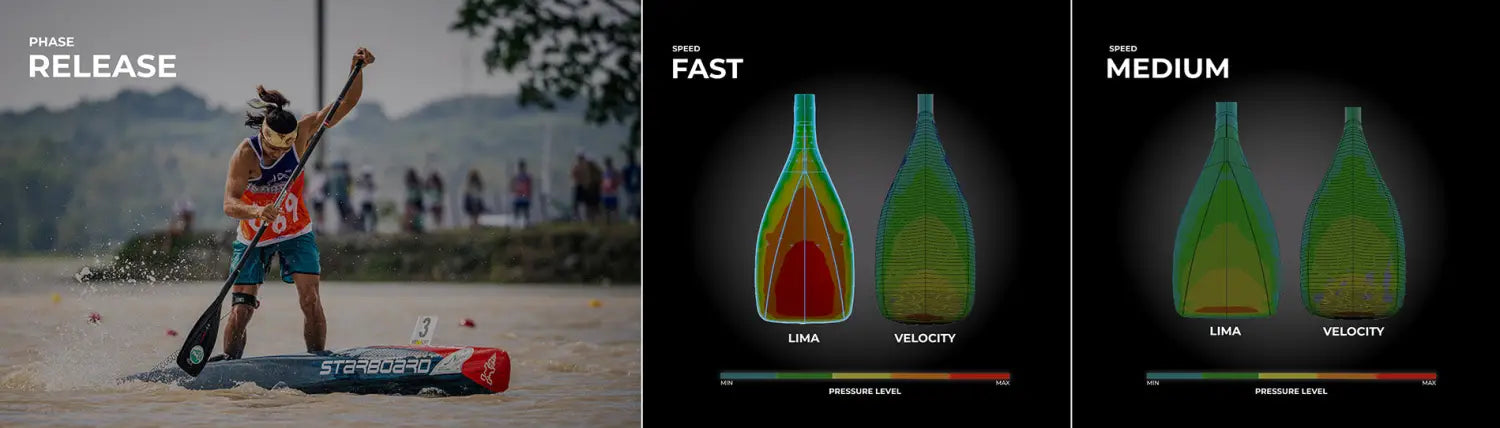
Choose Lima if you want:
- The strongest release power for instant speed.
- A paddle that amplifies your acceleration.
- A dynamic, responsive feel in sprints and short distances.
“With Lima, you can feel the acceleration instantly, especially during sprints or high-intensity starts,” - Roman Borisov, Starboard’s Paddle R&D Manager.
Velocity — the choice for distance and efficiency
If you’re chasing smoothness, endurance, and consistent speed, the Velocity paddle is built to keep you moving with less effort. It shines during the catch and mid-stroke phases where most forward momentum happens — delivering power early in the stroke so you can settle into a rhythm and go further with less fatigue.
At fast speeds (12–13 km/h), Velocity produces a stronger catch pressure of 107,610 Pa, compared to Lima’s 105,604 Pa, giving you a solid, stable entry into the water.
At medium speeds (9–10 km/h), Velocity continues to lead with 106,401 Pa at the catch and 105,840 Pa through the mid-stroke, compared to Lima’s 104,600 Pa and 105,599 Pa respectively — helping you hold speed more easily during long efforts.
At slow speeds (6–7 km/h), Velocity remains easy on the body with 105,484 Pa at the catch and a smooth, efficient release of 104,775 Pa, allowing you to paddle longer without strain, even during casual touring or warm-up sessions.
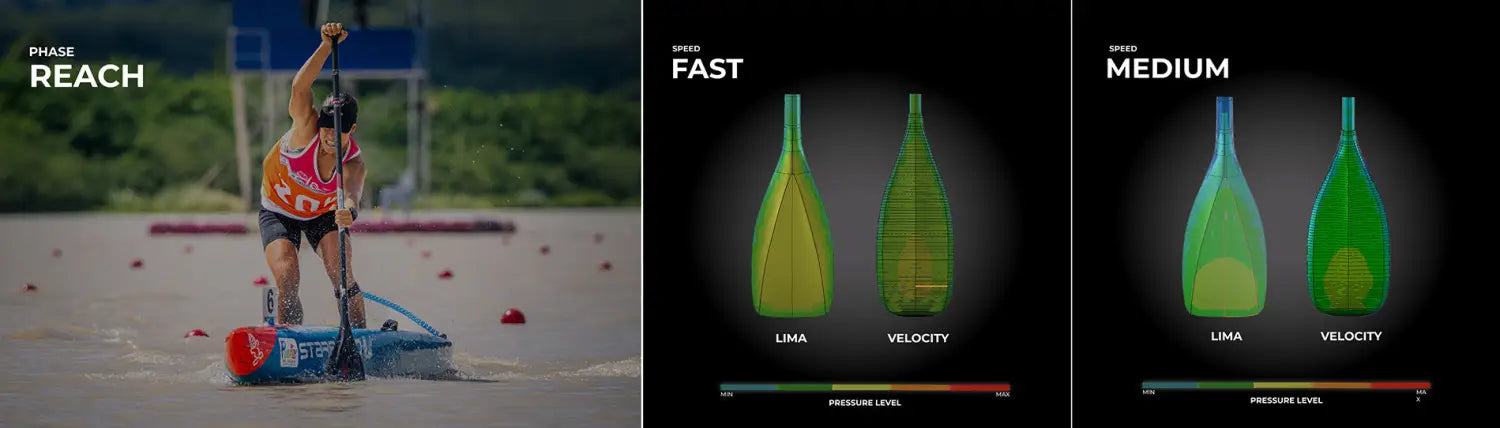
Choose Velocity if you want:
- Smoother, low-impact paddling over long distances.
- Stable power in the catch for a stronger pull with less fatigue.
- A paddle that keeps you feeling efficient and fresh in endurance paddling.
“Velocity helps you glide efficiently, keeping your body fresher for longer paddles and distance racing,” - Roman explains.
Summary
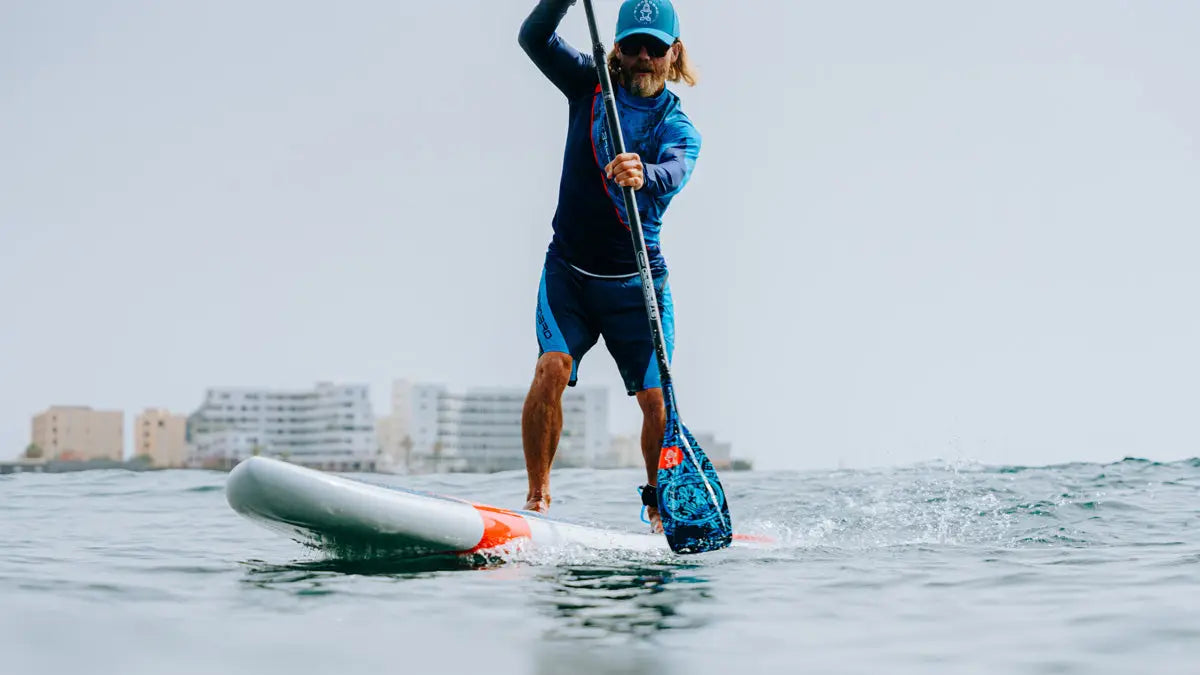
Explore Lima Paddle ›
Explore Velocity Paddle ›
Quick guide — which Starboard paddle is for you?
| LIMA | VELOCITY | |
|---|---|---|
| Best For | Sprints, Race Starts, Intervals | Distance, Endurance, Marathons |
| Feeling | Fast, explosive acceleration | Smooth, stable, easy stroke |
| Strength Zone | Strongest release force | Strongest catch & mid-stroke force |
| Power Numbers | Release up to 110,509 Pa | Catch up to 107,610 Pa |
| Ideal Speeds | Quick power at all speeds | Consistent power with less effort |
Top paddlers use Velocity for distance training and steady pacing, while switching to Lima for Sprints, short intervals, and power development. This combination ensures maximum race readiness and versatile performance.
CFD Study: The Science Behind Paddle Performance
Starboard’s CFD analysis doesn’t just measure Blade Surface pressure — it analyzes the fundamental forces that dictate paddling efficiency:
› Fz (Horizontal Force): The driving force that moves you forward. Higher Fz = stronger propulsion.
› Fy (Vertical Force): The upward or downward force during the stroke. High Fy often indicates wasted energy through water lift or blade submersion.
› Fy/Fz (%): The efficiency ratio.
- A moderate Fy/Fz value (20–30%) is ideal, indicating most of your power drives you forward.
- A high Fy/Fz (>80%) signals energy loss, with more effort going into lifting water rather than forward movement.
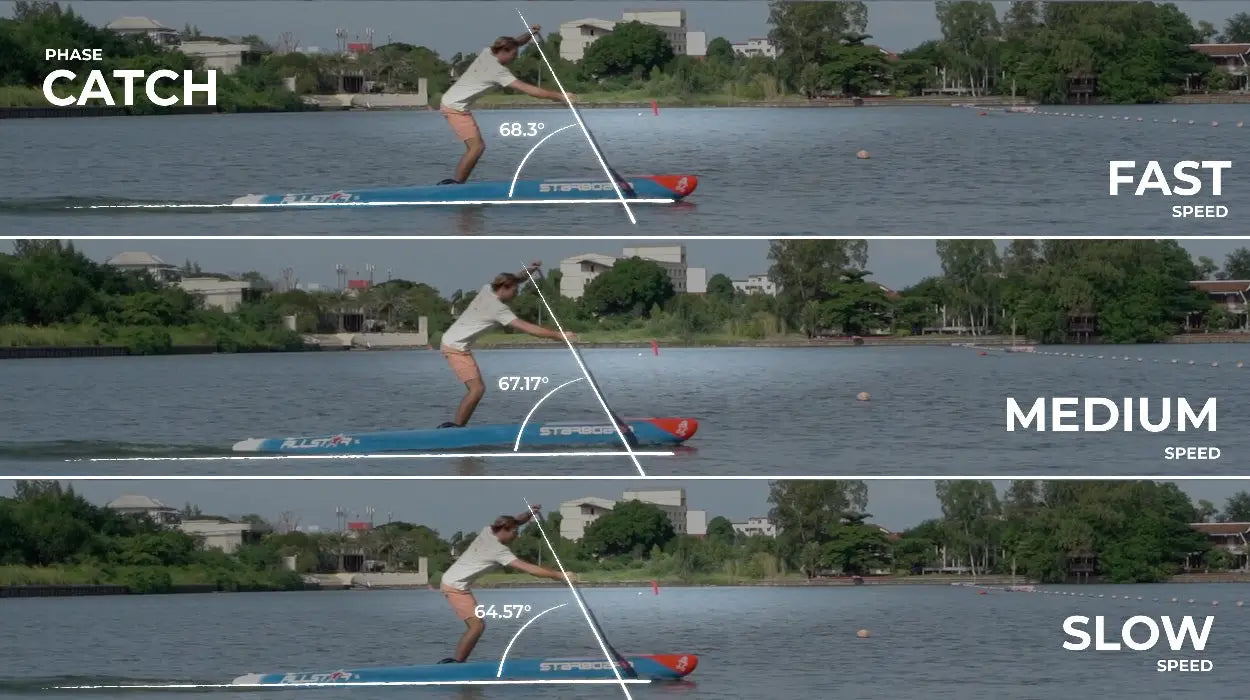
Catch Phase – Power Start
› At fast speeds, Velocity leads with Fz = -372.7 N, outperforming Lima (-326.6 N) but also showing more vertical lift (Fy = -245.2 N vs. Lima’s -199.5 N) with a Fy/Fz ratio of 65.8% vs. 61.1%.
› At medium speeds, Lima becomes inefficient with Fy/Fz = 100.4%, meaning as much lift as forward drive. Velocity stays more balanced at 69.8%.
› At slow speeds, both blades show high lift (Fy/Fz = 74.5% Lima vs. 79.3% Velocity), suggesting the need for a gentler entry to avoid energy waste.
Vertical Phase – Efficiency Zone
During the mid-stroke (shaft angle = 90°), efficiency peaks for both blades:
› Fast speed: Velocity leads in propulsion (Fz = -444.4 N) vs. Lima (-276.2 N) with efficient Fy/Fz = 20.5% vs. 17.9%.
› Medium speed: Both are close in Fz (Velocity = -256.8 N, Lima = -259.7 N) with Velocity slightly higher lift (Fy/Fz = 21.2% vs. 17.7%).
› Slow speed: Efficiency remains good (Fy/Fz under 25%) with Velocity = 23.3%, Lima = 19.6% — this is the most efficient part of the stroke.
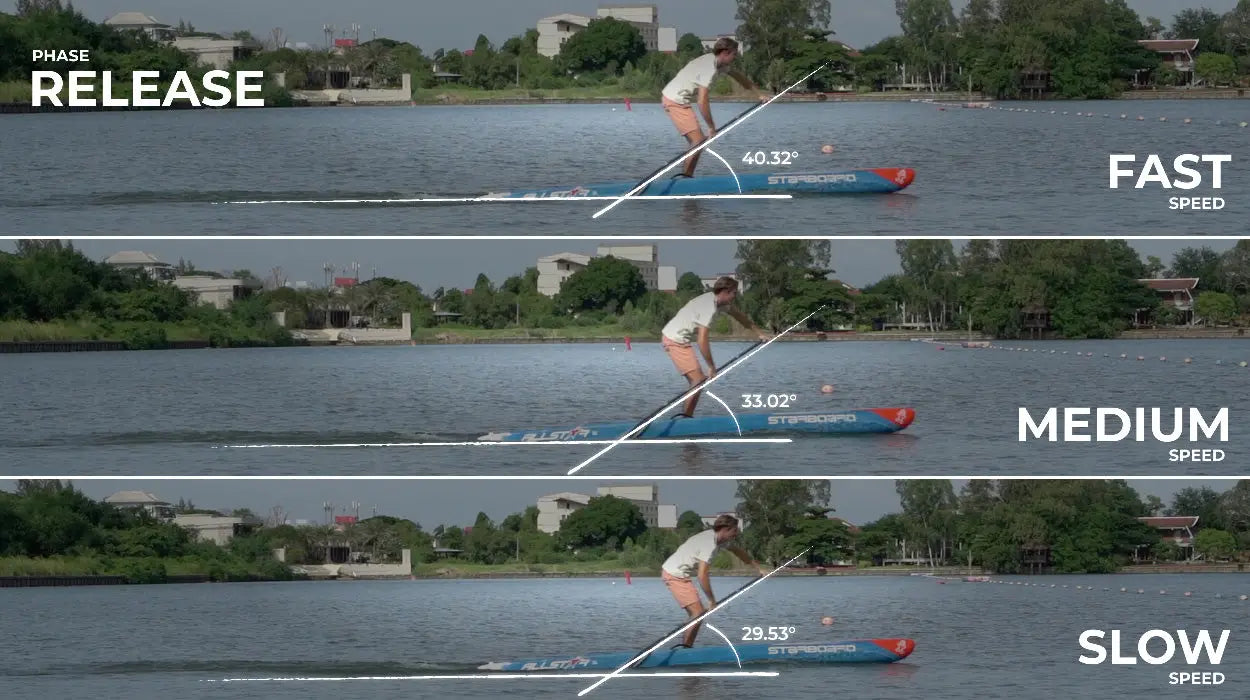
Exit Phase
At the exit phase, both paddles experience a significant rise in vertical force, reducing forward efficiency:
› Fast speed: Fy/Fz = 88.2% (Lima) and 80.7% (Velocity) — strong upwards lift means you should exit before this phase.
› Medium speed: Lima reaches 113.8%, Velocity 108.6%.
› Slow speed: Fy/Fz jumps to 126% (Lima) and 119% (Velocity) — clear evidence to avoid pulling too far back.
Key Takeaways (With Data):
› Velocity L provides more forward propulsion (up to -444.4 N) but requires good stroke timing to prevent unnecessary lift.
› Lima L delivers explosive release power (Fy = 272.2 N at fast speed) but sacrifices efficiency after the vertical phase.
› Vertical stroke = maximum efficiency, especially around 90° shaft angle, with optimal Fy/Fz ratios (17–23%).
› Early blade exit is crucial, especially at low and medium speeds, to prevent energy loss from excessive lift (>100% Fy/Fz).
“The numbers are clear — Velocity generates more raw drive, Lima delivers quicker acceleration”
CFD research by Aubin Petit, a mechanical engineer in an aeronautic company in Toulouse, France.
Article by Roman Borisov, Starboard’s Paddle R&D Manager.